当大多数人关注房地产市场时,通常会先看“刚刚成交了什么;。成交数据当然很重要,但它本质上是回顾性的。它告诉我们,买家和卖家在几天

Dated: April 26 2026
Views: 85
For years, a lot of buyers have approached the market with a pretty simple assumption: if you want a brand-new home, you are going to pay a major premium over an existing one.
That assumption is not completely wrong. New construction is still generally more expensive on a price-per-square-foot basis across the OKC metro. But these two graphs show something important happening right now:
the gap between existing homes and new homes has compressed.
And that matters, because once the spread gets tighter, buyers start comparing the two options very differently.
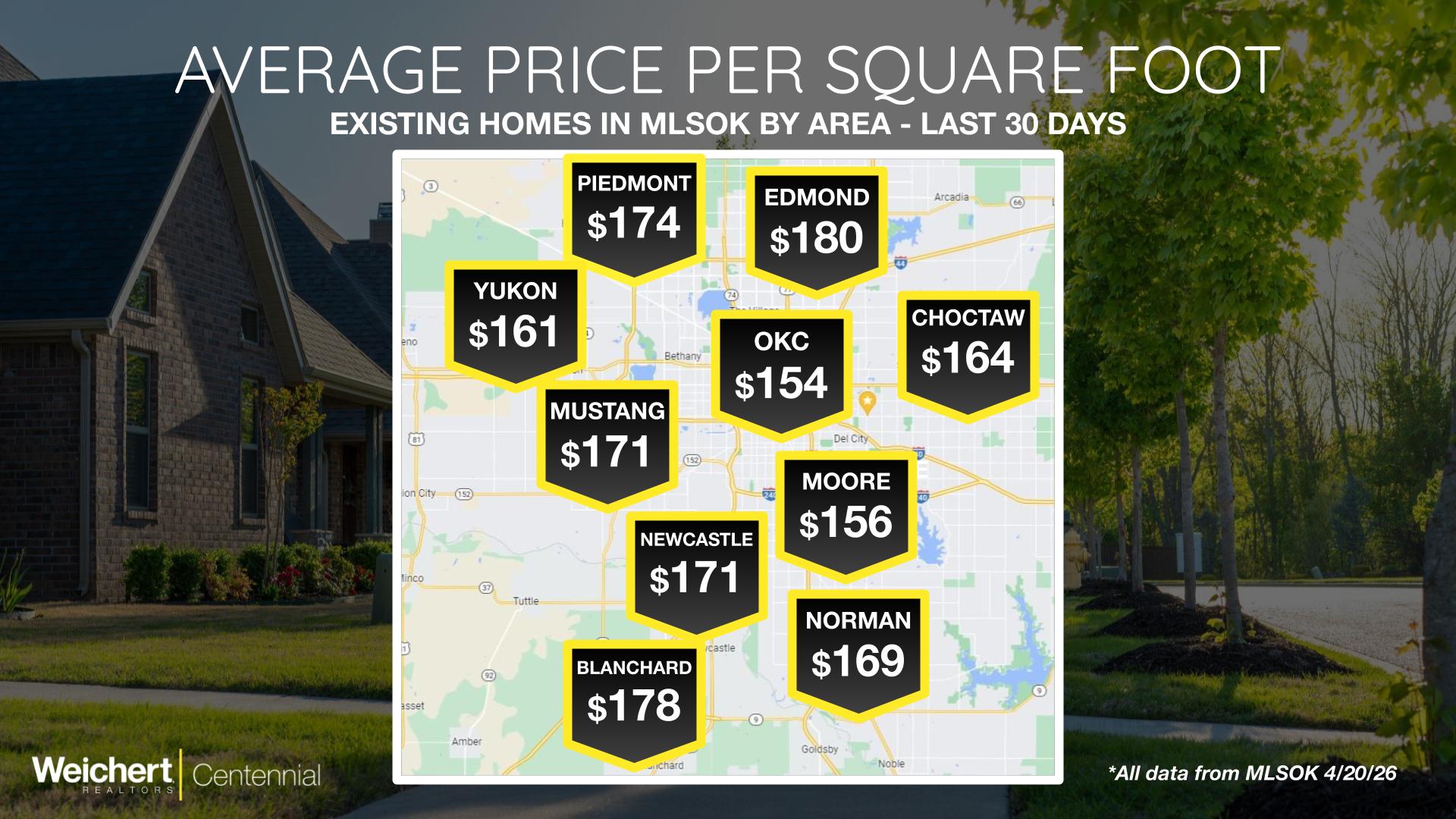
Let’s begin with the existing-home side, because this is still where most buyers naturally start.
Based on the last 30 days of MLSOK existing home sales by area, price per square foot looks like this:
That puts most existing homes in a fairly defined band, with the lower end in OKC and Moore, and the higher end in Edmond, Blanchard, and Piedmont.
The key takeaway here is that existing homes are not “cheap” across the board. In some parts of the metro, the price per foot on an existing home is already pushing into the mid-to-upper $170s, and Edmond is sitting right at $180.
So before buyers even look at new construction, the baseline for existing homes is already higher than many people may assume.
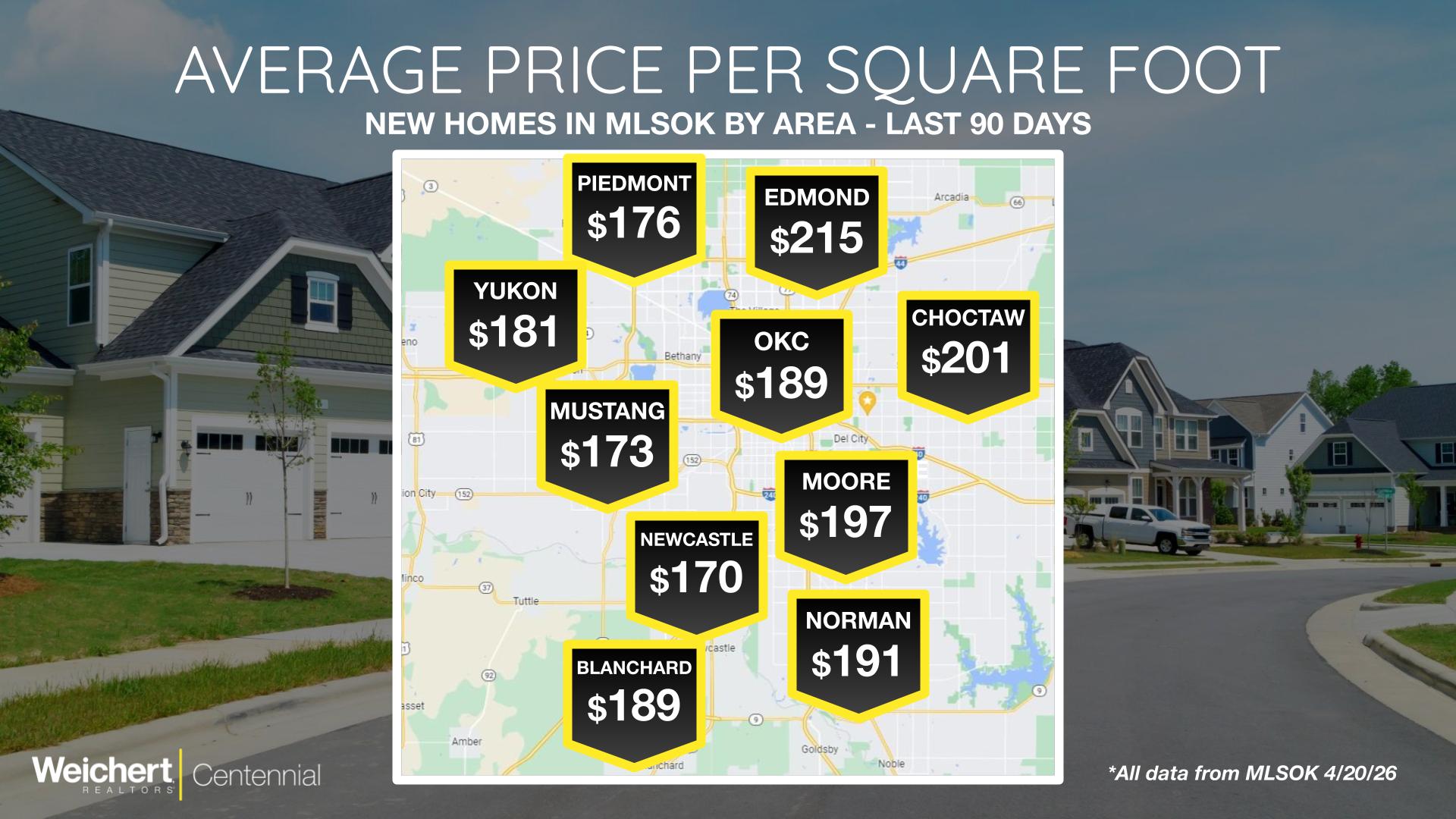
Shift over to new homes in MLSOK over the last 90 days, and the numbers do move up:
At first glance, that looks exactly like what people expect: new homes cost more.
And yes, in most areas they do.
But the more important question is not whether they are higher. The more important question is how much higher.
That is where the story gets interesting.
In a lot of these markets, the spread between existing homes and new construction is no longer some massive jump.
Here are a few examples:
In some places, like Piedmont and Mustang, the difference is almost shockingly tight. In others, like Edmond and OKC, the premium is more noticeable, but still not necessarily as dramatic as many buyers would expect when they hear the phrase “new construction.”
That is the real takeaway from these graphs: the decision between existing and new is no longer as obvious on price alone.
This may be the most important part of the conversation.
The new-construction graph shows sticker price per square foot. It does not reflect what many builders are offering right now in order to move inventory or stay competitive.
That can include:
Those things matter because they change the effective cost of the home.
A buyer may look at a new home and think it is clearly more expensive than an existing one, but once you factor in a rate buydown or several thousand dollars in closing costs, that gap can tighten even further.
In some cases, the monthly payment difference may shrink more than the headline price suggests.
If you are buying in the OKC metro right now, the old shortcut of “existing is the value option, new is the premium option” is getting less reliable.
Existing homes still offer advantages:
New homes offer different advantages:
The point is not that new construction is always the better deal. It is that the pricing gap has narrowed enough that buyers should be comparing both more carefully.
These two graphs show a market shift that buyers should not ignore.
Yes, new construction still tends to be higher on a price-per-square-foot basis. But across much of the OKC metro, the spread between existing and new has tightened considerably. And once builder incentives are layered in, the real-world difference can get even smaller.
That means buyers who rule out new construction too quickly may be missing viable options. And buyers who assume existing homes are automatically the clear bargain may need to run the numbers a little more carefully.
Because in this market, the gap between old and new is no longer nearly as wide as many people think.

Real estate is more than just buying and selling homes—it’s about helping people move forward in life. I pride myself on being a good listener and lifelong learner, always focused on under....
When most people look at the housing market, they focus on what just sold.Closed sales are useful, but they are also backward-looking. They tell us what buyers and sellers agreed to days or weeks.
One of the easiest ways to misunderstand the housing market is to look at one number and assume it tells the whole story.That is especially true with average sales price.The latest MLSOK data shows
 Copyright© 2026 MLSOK, Inc. listing content is believed to be accurate but is not guaranteed. Subject to verification by all parties. The listing information being provided is for consumers personal, non?commercial use and may not be used for any purpose other than to identify prospective properties consumers may be interested in purchasing. This listing data is copyrighted and may not be transmitted, retransmitted, copied, framed, repurposed, or altered in any way for any other site, individual
and/or purpose without the express written permission of MLSOK, Inc. Information last updated on September 22, 2026 5:26 PM UTC
© 2026 OKC Metropolitan Association of REALTORS® (OKMAR). All rights reserved.
Disclaimer: All information deemed reliable but not guaranteed and should be independently verified. All properties are subject to prior sale, change or withdrawal. Neither listing broker(s) nor September 22, 2026 5:26 PM UTC shall be responsible for any typographical errors, misinformation, misprints and shall be held totally harmless.
Data last updated on September 22, 2026 5:26 PM UTC
Show More...
Copyright© 2026 MLSOK, Inc. listing content is believed to be accurate but is not guaranteed. Subject to verification by all parties. The listing information being provided is for consumers personal, non?commercial use and may not be used for any purpose other than to identify prospective properties consumers may be interested in purchasing. This listing data is copyrighted and may not be transmitted, retransmitted, copied, framed, repurposed, or altered in any way for any other site, individual
and/or purpose without the express written permission of MLSOK, Inc. Information last updated on September 22, 2026 5:26 PM UTC
© 2026 OKC Metropolitan Association of REALTORS® (OKMAR). All rights reserved.
Disclaimer: All information deemed reliable but not guaranteed and should be independently verified. All properties are subject to prior sale, change or withdrawal. Neither listing broker(s) nor September 22, 2026 5:26 PM UTC shall be responsible for any typographical errors, misinformation, misprints and shall be held totally harmless.
Data last updated on September 22, 2026 5:26 PM UTC
Show More...
