当大多数人关注房地产市场时,通常会先看“刚刚成交了什么;。成交数据当然很重要,但它本质上是回顾性的。它告诉我们,买家和卖家在几天

Dated: January 22 2026
Views: 243
After a quiet end to the year, the Greater Oklahoma City housing market has delivered a clear and measurable shift in early January. New data from MLSOK shows a sharp rebound in homes going under contract, both in week-to-week activity and in year-over-year comparisons across several key communities.
This update focuses on two critical indicators:
Homes under contract over the last six weeks, and
Year-over-year contract activity from January 1 to January 15 by area
Together, these numbers provide one of the clearest demand signals we’ve seen in months.
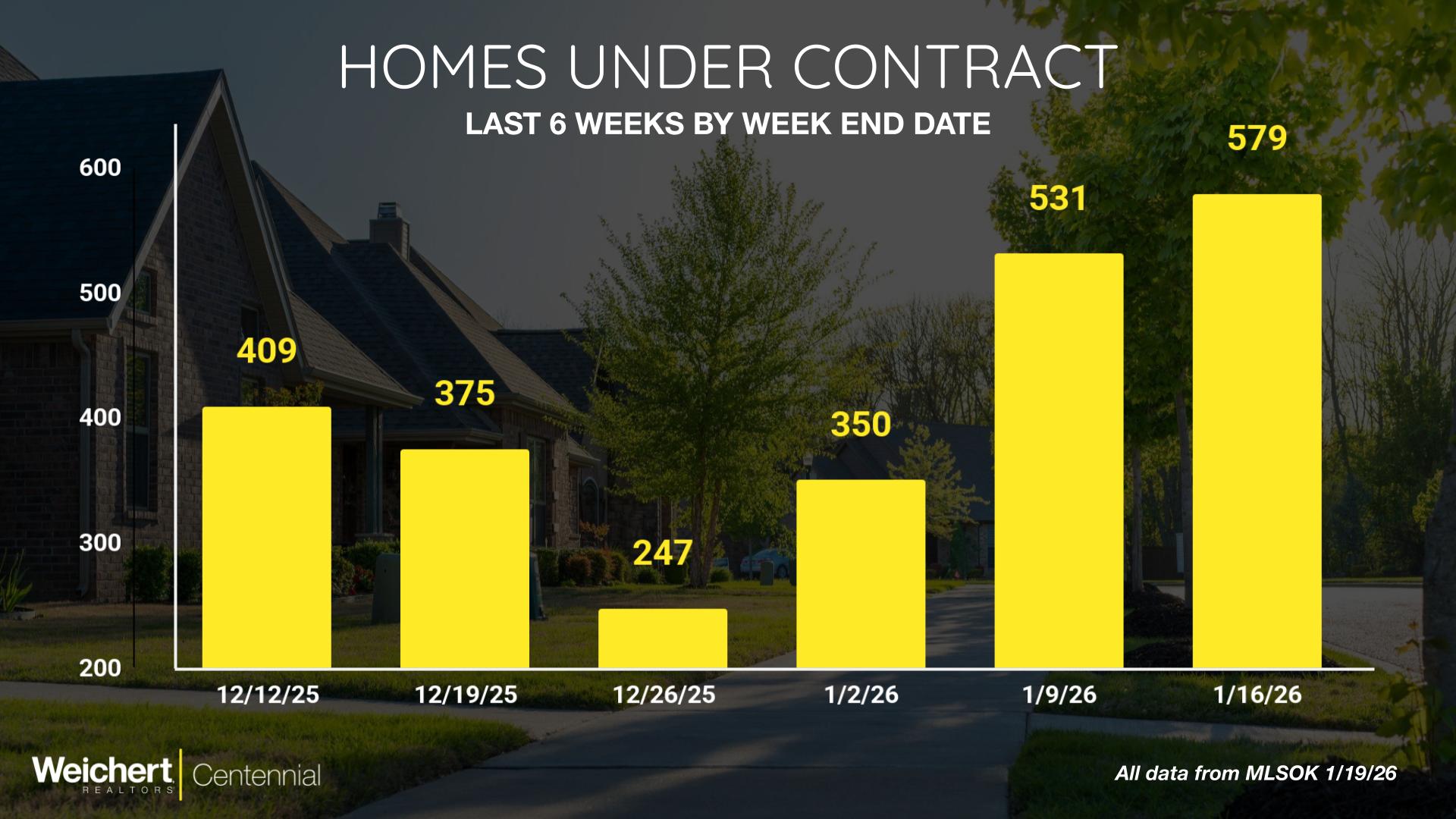
The six-week trend tells a familiar seasonal story—followed by an unusually strong bounce.
During the heart of the holiday season, contract activity slowed significantly. The lowest point came during the week ending December 26, when only 247 homes went under contract across the Greater OKC market. That dip reflected typical year-end behavior, with many buyers and sellers stepping back during late December.
However, the recovery was swift:
Week ending January 2: 350 homes under contract
Week ending January 9: 531 homes under contract
Week ending January 16: 579 homes under contract
In just three weeks, the market more than doubled its contract volume. That kind of acceleration matters. It suggests that buyer demand didn’t disappear during the holidays—it paused. Once January arrived, activity resumed quickly and decisively.
From a market-health perspective, this type of rebound often signals renewed confidence from buyers who were waiting for the calendar to turn before re-entering the market.
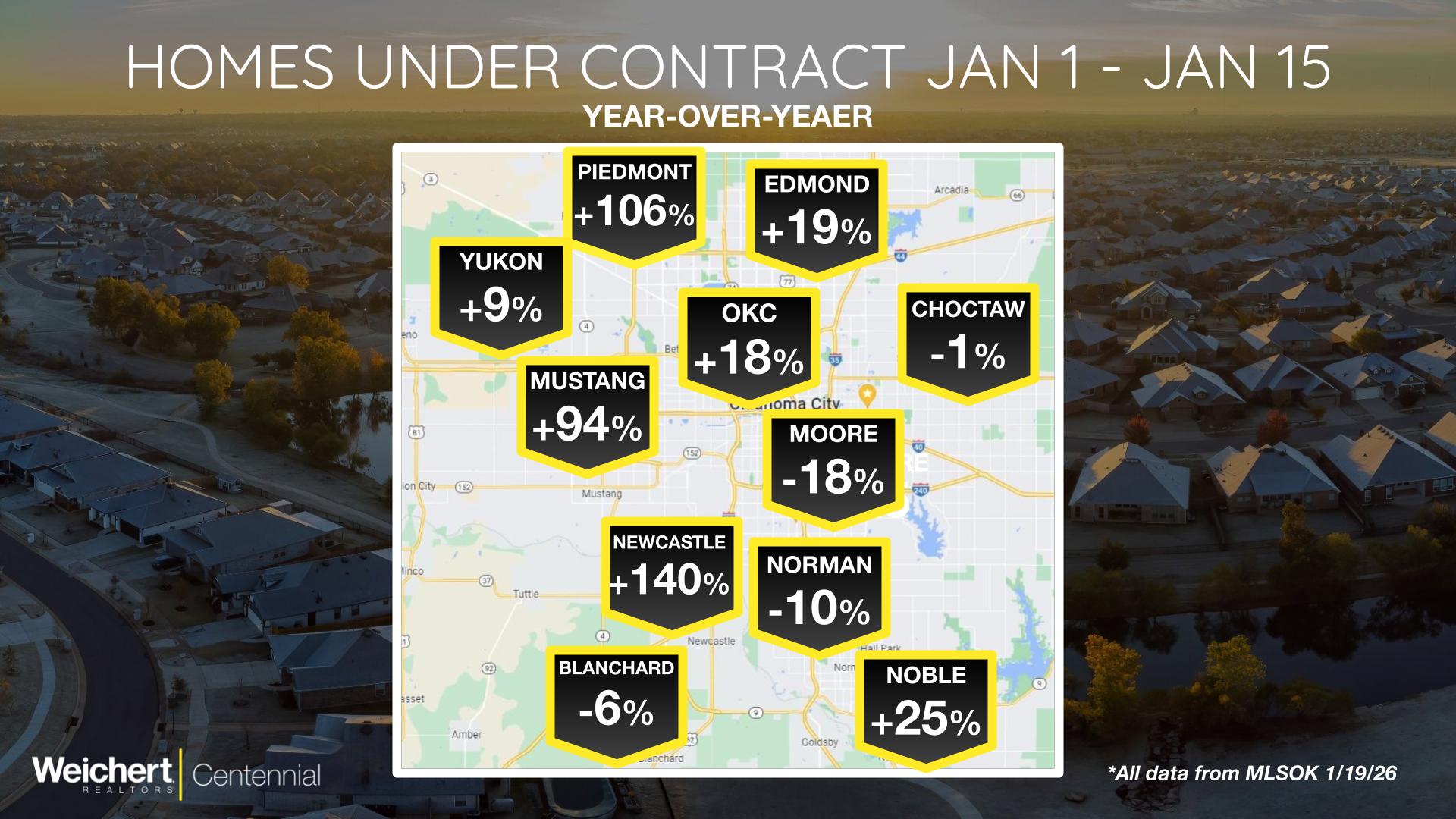
Looking at January 1–15 year-over-year contract activity adds another important layer. While the overall market is up, the gains are not evenly distributed across all communities.
Some areas posted dramatic increases:
These jumps indicate a significant rise in buyer activity compared to the same period last year. In these markets, demand has returned quickly and aggressively, suggesting strong interest relative to available inventory.
Several larger areas also posted solid gains:
At the same time, not every market moved higher:
These declines don’t necessarily indicate weakness, but they do show that buyer behavior is becoming more selective. Demand is concentrating in specific pockets rather than lifting all areas equally.
When contract volume rises this quickly at the start of the year, it often sets the tone for the months ahead. Buyers who delayed decisions in late 2025 are clearly re-engaging, and sellers entering the market now are doing so into a more active environment than just a few weeks ago.
For sellers, this data suggests that pricing, presentation, and timing matter more than ever. In areas where contracts are surging, well-positioned homes may move faster as competition among buyers increases. In areas showing year-over-year declines, strategy becomes even more important to attract attention.
For buyers, the takeaway is equally important. Rising contract counts mean more competition, especially in neighborhoods seeing triple-digit percentage increases. Understanding local trends—not just metro-wide headlines—can make a real difference in negotiating power and timing.
The Greater OKC housing market did not start 2026 quietly. After a predictable holiday slowdown, activity rebounded sharply, with 579 homes under contract in the most recent week and strong year-over-year gains in several key areas.
Rather than signaling a single, uniform market, this data points to a more localized and strategic environment, where neighborhood-level trends matter more than ever. As January continues, these early numbers will likely shape pricing, inventory movement, and buyer behavior heading into spring.
If you want to understand how these trends apply specifically to your neighborhood—or what they mean for your next move—local data is the key.

Real estate is more than just buying and selling homes—it’s about helping people move forward in life. I pride myself on being a good listener and lifelong learner, always focused on under....
When most people look at the housing market, they focus on what just sold.Closed sales are useful, but they are also backward-looking. They tell us what buyers and sellers agreed to days or weeks.
One of the easiest ways to misunderstand the housing market is to look at one number and assume it tells the whole story.That is especially true with average sales price.The latest MLSOK data shows
 Copyright© 2026 MLSOK, Inc. listing content is believed to be accurate but is not guaranteed. Subject to verification by all parties. The listing information being provided is for consumers personal, non?commercial use and may not be used for any purpose other than to identify prospective properties consumers may be interested in purchasing. This listing data is copyrighted and may not be transmitted, retransmitted, copied, framed, repurposed, or altered in any way for any other site, individual
and/or purpose without the express written permission of MLSOK, Inc. Information last updated on September 22, 2026 5:26 PM UTC
© 2026 OKC Metropolitan Association of REALTORS® (OKMAR). All rights reserved.
Disclaimer: All information deemed reliable but not guaranteed and should be independently verified. All properties are subject to prior sale, change or withdrawal. Neither listing broker(s) nor September 22, 2026 5:26 PM UTC shall be responsible for any typographical errors, misinformation, misprints and shall be held totally harmless.
Data last updated on September 22, 2026 5:26 PM UTC
Show More...
Copyright© 2026 MLSOK, Inc. listing content is believed to be accurate but is not guaranteed. Subject to verification by all parties. The listing information being provided is for consumers personal, non?commercial use and may not be used for any purpose other than to identify prospective properties consumers may be interested in purchasing. This listing data is copyrighted and may not be transmitted, retransmitted, copied, framed, repurposed, or altered in any way for any other site, individual
and/or purpose without the express written permission of MLSOK, Inc. Information last updated on September 22, 2026 5:26 PM UTC
© 2026 OKC Metropolitan Association of REALTORS® (OKMAR). All rights reserved.
Disclaimer: All information deemed reliable but not guaranteed and should be independently verified. All properties are subject to prior sale, change or withdrawal. Neither listing broker(s) nor September 22, 2026 5:26 PM UTC shall be responsible for any typographical errors, misinformation, misprints and shall be held totally harmless.
Data last updated on September 22, 2026 5:26 PM UTC
Show More...
