At first glance, the latest MLSOK numbers make the market look remarkably strong for sellers.Across nearly every featured OKC-area town, homes are selling for an average of 98% to 100% of list.

Dated: September 23 2026
Views: 18
At first glance, the latest MLSOK numbers make the market look remarkably strong for sellers.
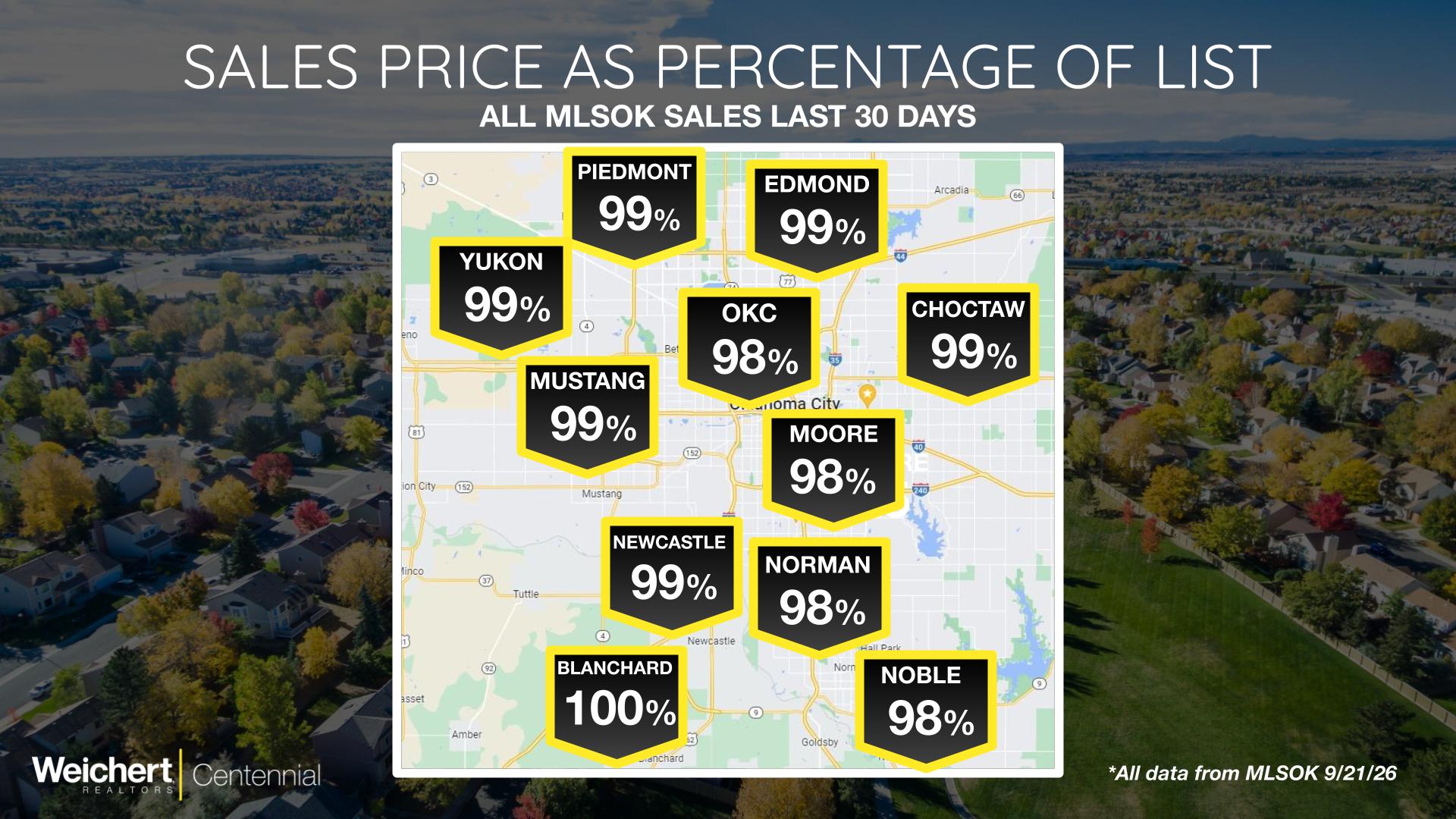
Across nearly every featured OKC-area town, homes are selling for an average of 98% to 100% of list price. Piedmont, Edmond, Yukon, Mustang, Choctaw, and Newcastle are all around 99% of list price. Oklahoma City, Moore, Norman, and Noble are around 98%, while Blanchard rounds to 100%.
If that were the only chart you saw, it would be easy to conclude that sellers are essentially getting what they ask for.
But the second chart changes the story.
It looks specifically at sales that accomplished two things at the same time: the home sold at or above list price, and the seller gave no concessions.
Suddenly, the percentages are much smaller.
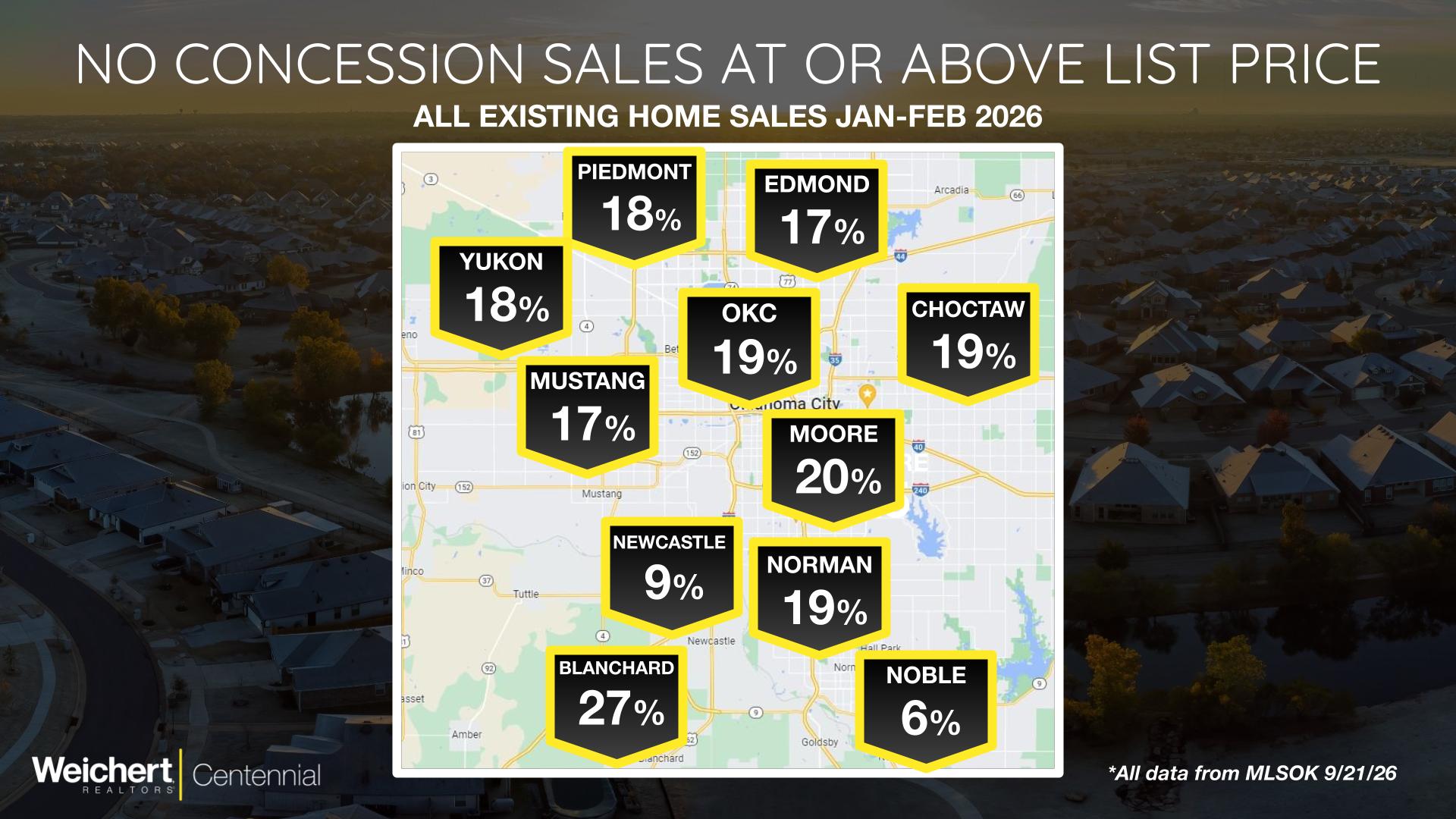
Only 20% of Moore sales met both conditions. Oklahoma City, Choctaw, and Norman were at 19%. Piedmont and Yukon were at 18%, while Edmond and Mustang were at 17%. Newcastle dropped to just 9%, and Noble was only 6%. Blanchard was the strongest of the featured markets at 27%.
That creates one of the more interesting contradictions in the current housing market.
Homes are generally selling very close to list price, yet relatively few sellers are walking away with a completely clean, at-or-above-list transaction with no financial help going back to the buyer.
In other words, a 99% sale-to-list ratio does not necessarily mean the seller gave up only 1%.
The negotiation may be happening somewhere else.
A seller might accept slightly less than asking price. They might agree to contribute toward closing costs. They might help fund a mortgage rate buydown. They may offer repair credits or another financial concession. Sometimes several of those things happen in the same transaction.
That is why simply comparing list price and sales price can miss an important part of what buyers and sellers are actually negotiating.
Consider a $350,000 listing that sells for $346,500. On paper, that is 99% of list price, which sounds like a very strong result for the seller. But if the seller also contributes $7,000 toward the buyer’s closing costs or financing, the economics of that transaction look different than the headline sale-to-list percentage suggests.
The recorded sales price is still $346,500.
The seller just did more to get there.
This is particularly important when interpreting today’s market because buyers remain extremely sensitive to the total cost of purchasing a home. The negotiated sale price is only one piece of that equation. Cash needed at closing, mortgage rate, prepaid expenses, repairs, and monthly payment can all influence whether a buyer is willing or able to move forward.
That means a seller may decide that preserving the sales price while offering a concession is preferable to making a larger visible price reduction.
For buyers, this creates an important lesson: do not assume a home selling near list price means there was no room to negotiate.
The data suggests the opposite.
Take Oklahoma City as an example. The average sale is around 98% of list price, yet only 19% of transactions sold at or above list with no concessions. Norman tells a similar story: roughly 98% of list price, but only 19% were clean at-or-above-list transactions without concessions.
The difference is even more striking in Newcastle. Homes averaged around 99% of list price, yet only 9% sold at or above list without concessions.
Noble is perhaps the clearest example. Its average sale price was still roughly 98% of list, but just 6% of sales were at or above asking price with no concessions.
Those numbers show why buyers should look beyond the asking price when writing an offer. The opportunity may not always be a dramatic price reduction. It might instead come through the structure of the contract.
For sellers, there is an equally important lesson.
A high sale-to-list percentage is encouraging, but it should not create unrealistic expectations about negotiation. The market may still support strong prices while buyers simultaneously expect some help getting the transaction across the finish line.
That is a very different environment from a market where sellers routinely receive full-price offers with no concessions and few contingencies.
It is also why pricing strategy matters so much. If buyers are already negotiating concessions, an overpriced home may be forcing the seller to negotiate twice: first through a price adjustment and later through concessions.
The strongest position may come from getting the initial price right, attracting buyers early, and then deciding which parts of the transaction are worth negotiating.
The bigger story from these two graphs is that the gap between asking price and sales price is only one measure of negotiation.
MLSOK homes are still closing remarkably close to list price in many communities. That is real.
But the relatively small percentage of transactions reaching or exceeding list price without concessions tells us there is much more happening beneath the headline number.
The current market is not defined by huge discounts.
It is defined by lots of smaller negotiations.
And when you add those negotiations together, they can represent thousands of dollars even when the final sales price still looks very close to asking.
Data from MLSOK, 9/21/26.

Real estate is more than just buying and selling homes—it’s about helping people move forward in life. I pride myself on being a good listener and lifelong learner, always focused on under....
At first glance, the latest MLSOK numbers make the market look remarkably strong for sellers.Across nearly every featured OKC-area town, homes are selling for an average of 98% to 100% of list.
When most people look at the housing market, they focus on what just sold.Closed sales are useful, but they are also backward-looking. They tell us what buyers and sellers agreed to days or weeks.
 Copyright© 2026 MLSOK, Inc. listing content is believed to be accurate but is not guaranteed. Subject to verification by all parties. The listing information being provided is for consumers personal, non?commercial use and may not be used for any purpose other than to identify prospective properties consumers may be interested in purchasing. This listing data is copyrighted and may not be transmitted, retransmitted, copied, framed, repurposed, or altered in any way for any other site, individual
and/or purpose without the express written permission of MLSOK, Inc. Information last updated on September 22, 2026 5:26 PM UTC
© 2026 OKC Metropolitan Association of REALTORS® (OKMAR). All rights reserved.
Disclaimer: All information deemed reliable but not guaranteed and should be independently verified. All properties are subject to prior sale, change or withdrawal. Neither listing broker(s) nor September 22, 2026 5:26 PM UTC shall be responsible for any typographical errors, misinformation, misprints and shall be held totally harmless.
Data last updated on September 22, 2026 5:26 PM UTC
Show More...
Copyright© 2026 MLSOK, Inc. listing content is believed to be accurate but is not guaranteed. Subject to verification by all parties. The listing information being provided is for consumers personal, non?commercial use and may not be used for any purpose other than to identify prospective properties consumers may be interested in purchasing. This listing data is copyrighted and may not be transmitted, retransmitted, copied, framed, repurposed, or altered in any way for any other site, individual
and/or purpose without the express written permission of MLSOK, Inc. Information last updated on September 22, 2026 5:26 PM UTC
© 2026 OKC Metropolitan Association of REALTORS® (OKMAR). All rights reserved.
Disclaimer: All information deemed reliable but not guaranteed and should be independently verified. All properties are subject to prior sale, change or withdrawal. Neither listing broker(s) nor September 22, 2026 5:26 PM UTC shall be responsible for any typographical errors, misinformation, misprints and shall be held totally harmless.
Data last updated on September 22, 2026 5:26 PM UTC
Show More...
